Five Mexican drinks own summer better than the Margarita. One of them is beer with chilli salt. One is fermented pineapple peel. One is a flower, brewed cold, drunk by the litre on a Sunday afternoon. The Margarita won the world, but Mexico's summer fridge is wider than one cocktail — and the rest of it travels well to Camden.
Here are five drinks we pour at Frida Camden from May through September, what each one is built from, and why Mexicans have been drinking them longer than the United States has been making frozen margaritas.
Why summer in Mexico drinks differently
Mexico is hot and varied. The Yucatán is humid and slow; the Bajío is dry and bright; CDMX climbs to 2,200 metres and gets a different kind of summer altogether. Each region built a drink that fits its weather — light spirits with citrus on the Pacific coast, heavy fermented beverages in the highlands, beer-based refreshers in the north. None of those drinks is the Margarita.
The Margarita is, in fact, more popular in the United States and the UK than in Mexico. Mexicans drink it occasionally, and rarely frozen. What they drink instead is a wider, older menu — and that menu is what gets us through May to September at Frida.
1. Paloma — Mexico's most-poured cocktail
If a Mexican walks into a bar in Guadalajara on a 35°C afternoon, they're more likely to order a paloma than anything else. It's the country's de facto national cocktail, and it's almost embarrassingly simple: tequila blanco, grapefruit soda (Squirt or Jarritos Toronja are the canonical brands), a squeeze of lime, salt on the rim, served in a highball with a lot of ice.
The grapefruit is the trick. Citrus that's tart without being sweet, bitter without being heavy, carbonated to keep the drink from feeling like a glass of juice. The salt rim isn't decoration — it's structural; it pulls the bitterness forward.
At Frida we pour ours with Casa Noble tequila blanco and fresh ruby grapefruit, topped with a small amount of soda water rather than bottled grapefruit soda — drier, sharper, less sugary than the Mexican standard. The smoky version, made with mezcal instead of tequila, is the most-asked variant on a hot Saturday afternoon.
2. Michelada — beer with a personality
A michelada is what happens when Mexico decides that beer, by itself, is not enough. Take a cold lager (Modelo, Pacifico, Victoria), pour it over ice into a glass with a chilli-salt rim, add lime juice, a dash of Worcestershire sauce, a few drops of Maggi or soy, and — depending on region — either tomato juice (the central Mexican cubano version) or Clamato (the Sinaloa style with clam-tomato base). Stir, drink, repeat.
It looks like a Bloody Mary. It is not a Bloody Mary. The michelada is lighter, beer-driven rather than spirit-driven, and the chilli is on the rim — present but optional. The drink rebuilds itself with every sip as the rim dissolves and the beer warms slightly.
We serve micheladas at brunch, where they belong, alongside chilaquiles. We also serve them by the half-litre tankard when it's warm enough that one beer isn't going to do the job.
"If a Margarita is what Mexico made for the world, a paloma is what Mexico keeps for itself."
3. Agua Fresca — the one without alcohol
An agua fresca is literally "fresh water," and that undersells what's happening in the glass. Fruit (or a flower, or a seed) is blended with water, sweetened lightly, sieved, and served over ice. The result is brighter and lighter than juice, less sweet than soda, and exactly what Mexican summer needs at lunch.
The three classic varieties are:
- Agua de jamaica — hibiscus flowers steeped in cold water with a touch of sugar. Deep red, tart, slightly floral. The most popular and the oldest of the three.
- Agua de sandía — watermelon, water, lime, a pinch of salt. Tastes like summer in a glass.
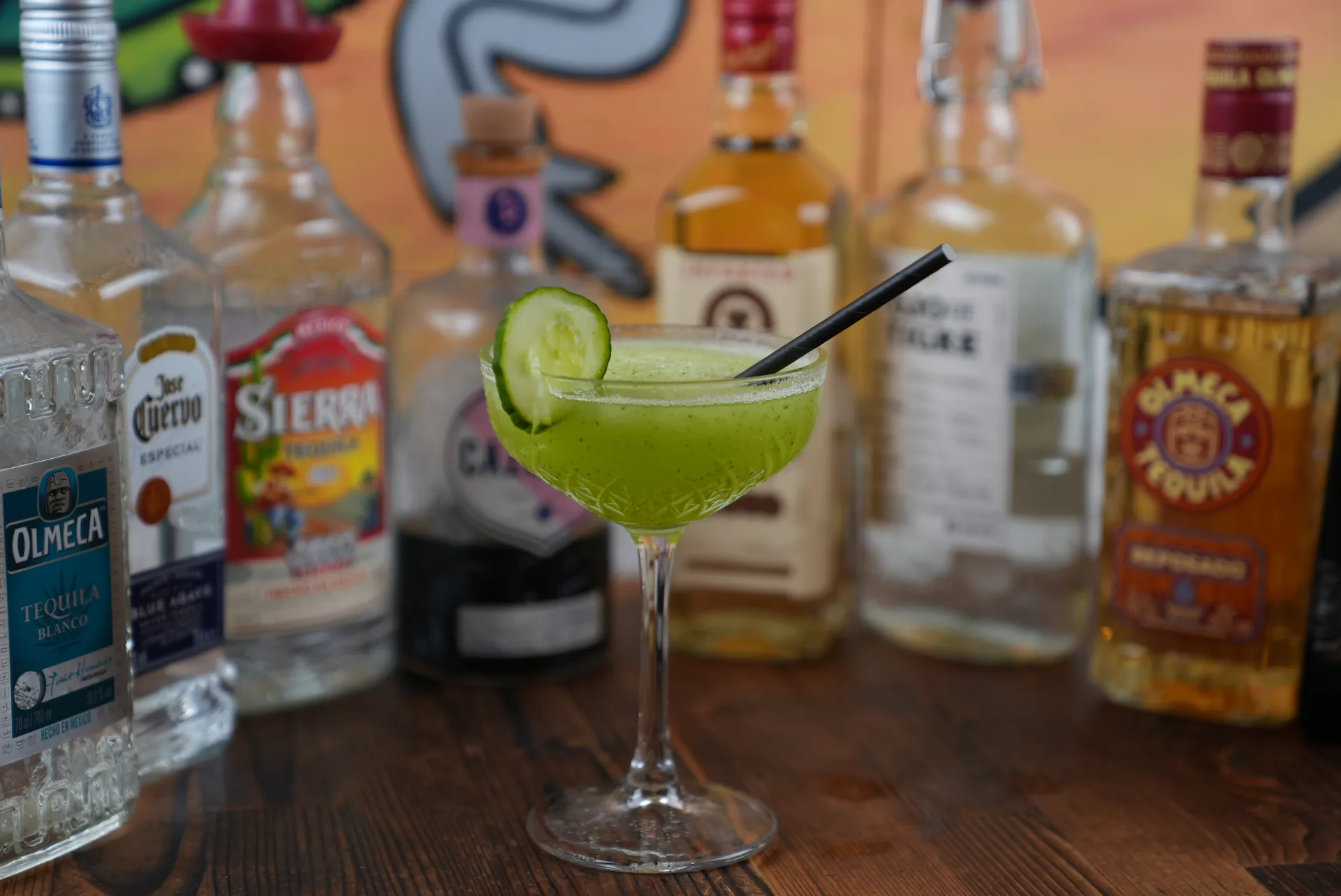
- Agua de pepino y limón — cucumber and lime, blended with mint sometimes. Almost a savoury cousin to lemonade; impossibly refreshing.
We rotate ours by week through the warm months. Jamaica is in the fridge year-round; sandía and pepino come and go with what's in season at the market. They are also the answer to "what can I drink that isn't a cocktail?" — which gets asked a lot at brunch.
4. Mezcal Mule — the smoky cousin
The Moscow Mule is vodka, ginger beer, lime, copper mug. The mezcal mule swaps the vodka for mezcal joven and changes everything else by extension. Where a Moscow Mule is clean and refreshing, a mezcal mule is smoky, complicated, and slightly dangerous in the right way.
The ginger beer (we use Fever-Tree) carries the citrus and the heat. The mezcal carries the smoke and the agave. The lime stitches the two together. A small piece of orange peel, expressed over the glass, finishes it. Served in the copper mug if we're being traditional, in a highball if we're being practical.
If you've read our piece on why we lean toward mezcal over tequila for sipping, this is one of the few cases where a mezcal cocktail genuinely works — the ginger and the lime give the mezcal somewhere to go. Most cocktails drown mezcal; this one converses with it.
5. Tepache — the fermented one
This is the one most people haven't tried, and the one most likely to convert them. Tepache is a lightly fermented drink made from pineapple peel, brown sugar (piloncillo, ideally), cinnamon, and clove, left to ferment in a clay pot for two or three days. The result is a sweet-tart, lightly fizzy, lightly alcoholic (around 1%) summer drink that Mexican street vendors sell from buckets with ladles.
It tastes like pineapple, vaguely like apple cider, and a little like very gentle kombucha. The carbonation is mild and natural. The cinnamon and clove are background notes, not foreground. It is the most overlooked Mexican summer drink in London, and it is the easiest one for someone with no Mexican drinking habits to fall in love with.
We make ours in batches every Friday for the weekend and serve it in chilled mugs. Vegan, low-alcohol, gluten-free, dairy-free, and somehow also delicious — which makes it almost the only drink that genuinely works for every dietary table.
What to drink with what
Mexican drinks don't apologise for the food. They argue with it, or chase it, or balance it. A loose pairing guide:
- Paloma + ceviche or grilled fish — bright citrus to clean citrus. Works on any seafood plate.
- Michelada + chilaquiles — brunch's perfect circle. Also works with eggs in any form.
- Agua fresca + anything spicy — the heat carrier. Especially good with our pastor tacos.
- Mezcal mule + mole — smoke into chocolate-chilli, no compromises on either side.
- Tepache + tacos — sweet-tart against fat-and-salt. Underrated, brilliant.
If you can't decide, the answer is usually the paloma. It pairs with everything; it never disappoints.
On the Frida menu
Of the five, three are on our regular cocktail list: paloma, michelada, agua fresca (with whichever flavour is in season). The mezcal mule moves on and off seasonally — it's available May through September most years. Tepache is only on Saturdays and Sundays, while the weekend batch holds out — once it's gone, it's gone until Friday.
For the full list, see our drinks menu. For a quieter table and an unhurried order, book a table — Tuesday and Wednesday evenings are the easiest, Saturday lunchtimes the hardest. The house margarita story is also worth reading if you want the longer view on why we make cocktails the way we do; and the recipe piece covers the technique.
Frequently asked questions
Is the Margarita really the most popular drink in Mexico?
No — it's more popular abroad. In Mexico, the paloma is the de facto national cocktail, ordered far more often than the Margarita. The Margarita made it to the US in the 1940s and grew into the world's bestselling tequila drink there; in Mexico itself, the paloma quietly outpaces it at most bars. It's one of those exports that became more famous than the original.
What's the difference between a michelada and a Bloody Mary?
Two main things: base spirit and structure. A Bloody Mary is built around vodka and is essentially a savoury cocktail with tomato juice doing the heavy lifting. A michelada is built around beer (usually a Mexican lager), with lime, Worcestershire and optional tomato adding character on top of the beer rather than replacing it. The chilli-salt rim is also a michelada signature; Bloody Marys usually skip it. Lighter, beer-driven, more refreshing.
Can I order a non-alcoholic option at Frida?
Yes. Agua frescas (jamaica year-round, sandía and pepino seasonally) are alcohol-free, vegan and gluten-free. We also pour tepache, which is technically fermented but sits at around 1% ABV — close enough to non-alcoholic that we list it among soft drinks for kitchen-test purposes. Smoothies and Mexican coffees round out the non-alcoholic side. If you're driving, pregnant, or just choosing to skip — we have plenty.
How is a mezcal mule different from a Moscow mule?
The spirit changes the whole drink. A Moscow Mule (vodka + ginger beer + lime) is clean and almost neutral — the ginger is the main flavour. A mezcal mule replaces the vodka with mezcal, which brings smoke, agave sweetness, and complexity that fights for attention with the ginger. The ginger still wins, but it has to work harder. Most people who like mezcal find the mezcal mule easier than mezcal neat; most people who don't think they like mezcal change their mind after one.
Do you make tepache at Frida?
Yes — fresh batches every Friday for weekend service. Pineapple peel, piloncillo (unrefined Mexican brown sugar), cinnamon, clove, water, fermented for two to three days in glass. Vegan and gluten-free. It runs out by Sunday evening most weeks, so a Saturday lunch visit is the most reliable way to try it. We don't ship or sell it to take away — fermentation continues after pouring, and the timing is part of the drink.
Save your table
Frida Camden, 40 Camden High Street, London NW1 0JH. Between Mornington Crescent and Camden Town tube. Open Sun–Thu 10:30–22:00 (last food orders 21:30), Fri–Sat 10:00–23:00 (last food orders 22:30). Book a table online or call us on +44 207 383 3733. ¡Salud, y buen verano!